In the Room With Iran’s Social Media Savants
Over ten years in Iran, I shadowed the leaders and filmmakers who have shaped the Revolutionary Guard’s media operation. The new generation of content creators coming to power now are is younger, quicker, and less afraid of the U.S.
Intelligence Engine
In the Room With Iran’s Social Media Savants
The new generation of IRGC content creators is younger, quicker, and less afraid of the U.S.
By
Narges Bajoghli,
a cultural anthropologist at Johns Hopkins SAIS
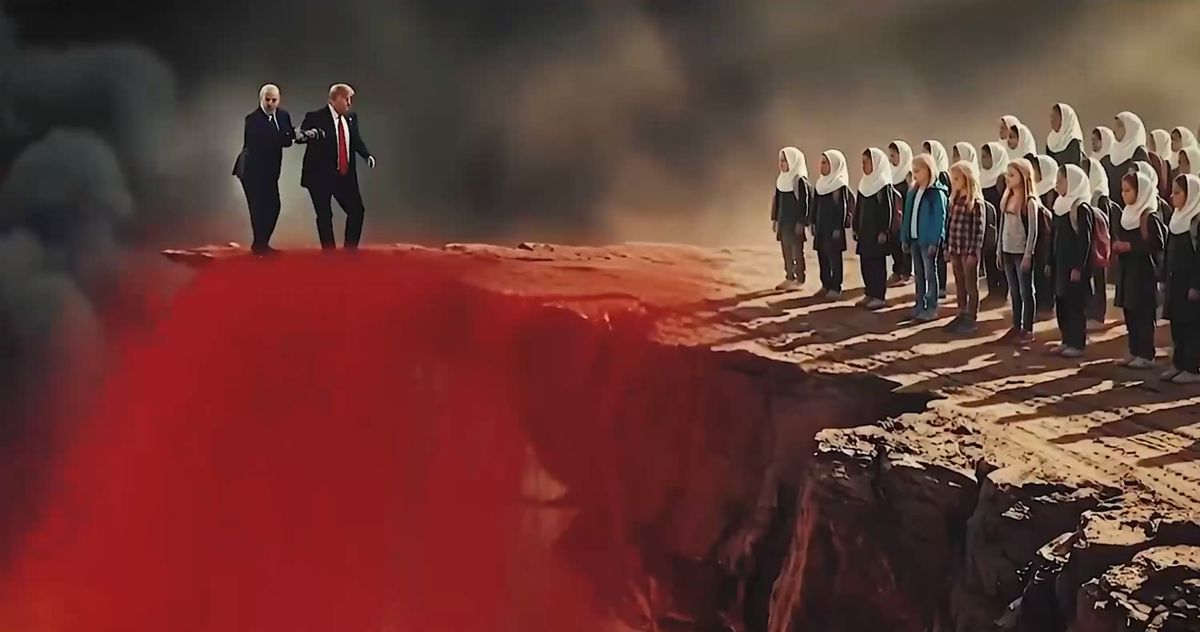
In a video made by an IRGC-backed production house, a group of blonde girls carrying folders labeled “Epstein File” join forces with the Iranian schoolgirls who were killed in a strike on Minab. They watch as Trump and Netanyahu go over the edge of a cliff into a river of fire below.
Video: Islamic Revolutionary Guard Corps
In a video made by an IRGC-backed production house, a group of blonde girls carrying folders labeled “Epstein File” join forces with the Iranian schoolgirls who were killed in a strike on Minab. They watch as Trump and Netanyahu go over the edge of a cliff into a river of fire below.
Video: Islamic Revolutionary Guard Corps
The missile moves slowly at first. It arcs across a pale sky in clean, almost gentle animation — the kind of motion you’d associate with a nature documentary, something migrating. Then you start to notice who it’s passing over.
A Native American man. A Vietnamese villager. A child from Palestine. Someone from Hiroshima. A child on Epstein island, followed by a schoolgirl, small and still, in the Iranian city of Minab who was killed when a strike hit her school. They look to the sky as if in reverence. The missile continues on its path. Below it, where the Statue of Liberty should be, stands something else: the animators have turned it into the Statue of Baal, the ancient deity the Bible associates with child sacrifice. The missile descends. The statue crumbles. Text fills the screen: “One Vengeance for All.”
The video, produced and distributed by a media group aligned with the Iranian Revolutionary Guard Corp., is less than a minute long. Watch it a few times and the construction becomes visible. Every figure in it was chosen because it would land for a specific community. The Native American man speaks to an American audience with a particular relationship to this country’s founding violence. The Vietnamese villager invokes a war that still organizes the left’s understanding of imperial overreach. Hiroshima is a specific kind of symbol — the thing that makes certain arguments about American moral authority impossible to complete. Palestine, in the years since October 7, needs no footnote: It has become the lens through which a generation reads every claim about western civilization and its discontents. The Iranian schoolgirl, who died in a strike that was covered briefly in western media and then forgotten, is placed in the sequence as if to say, “Her death is part of this lineage.” And the Epstein imagery is the key that unlocked a door that was already open. Almost instantly, the video was everywhere: downloaded, stripped of watermarks, reuploaded and shared devoid of context.
The missile video is one of more than dozens that the media arms of the IRGC have made in the first 39 days of the war — videos released in English, Arabic, and Persian that are dominating the narrative war across what might be called the Global South digital public and among millennial and Gen-Z Americans and Europeans: younger audiences on X, Instagram, TikTok, and Telegram who watched western coverage of Gaza and made their own conclusions about whose narratives to trust. These videos meet them exactly where they already are, whether that’s someone in Ohio who’s angry about the Epstein files or someone in Amman who has been watching Gaza for more than two years and has run out of patience for western lectures about proportionality. It was designed for people who carry a set of grievances and suspicions the video can walk into and inhabit, like a house that was already furnished.
I watch the videos go viral every day now. It has become a kind of compulsion. Each morning I open Telegram, Instagram, X and scroll through what arrived overnight from the production houses I have tracked over two decades of fieldwork. I watch the share counts. I watch Americans with no knowledge of and no interest in Iran forward videos made in Tehran to their followers as if they were sharing something they discovered themselves. In comment sections across platforms, people write, “Iran is fighting for all of us.”
I keep thinking about what this war was supposed to look like in the U.S. information environment. For the majority of the past 47 years, the image of Iran in American life has been surprisingly stable. Ted Koppel built the template in the winter of 1979, going on television every night to count the days Americans were held hostage in Tehran — a segment that ran so long it became Nightline, shaping what American television news would become. Nearly two weeks after the start of the hostage crisis in November 1979, Koppel looked into the camera and said something that has stayed with me for most of my adult life: “Iran has become more than simply a crisis. It is an obsession.” He meant it as a diagnosis. He could not have known he was writing the founding charter of the next half century of American foreign policy — the template that would organize every presidential address, every cable chyron, every moment of manufactured outrage about the Islamic Republic and the Middle East that would follow. Iran went on to occupy a fixed position in the American political imagination. The quintessential enemy. The irrational theocracy. The state that could not be reasoned with, only contained or destroyed. The images associated with it were of fanatical crowds and burning flags. Axis of evil. State sponsor of terror. The story was repeated so consistently that it stopped feeling like a story and started feeling like the weather.
The strikes on Tehran were meant to be the moment when all that patient framing finally delivered its intended result: an American public that understood, or believed it understood, why this had to happen. But the levers aren’t moving the way they used to. The formal U.S. and Israeli media infrastructure relies on institutional trust that has been catastrophically degraded over the past few years. When AFP, the New York Times, the BBC, and CNN are perceived as having failed on Gaza — a perception that is widespread and not entirely wrong — western media loses the ambient credibility on which it usually coasts.
At the same time, something changed across the Axis of Resistance — the Iran-led network of forces that includes Hezbollah, Hamas, the Houthis, and Shiʽa militias in Iraq and Syria, bound together by a shared opposition to U.S. and Israeli power in the region — in how these groups speak to the world. The change began in earnest on October 7. When Hamas launched its attack on Israel, cameras were as central to the operation as weapons. GoPro footage of the breach, drone video of the assault — within hours, social-media-ready content was already circulating. During the temporary cease-fire in November 2023, Hamas released its Israeli captives in Gaza with cameras positioned to capture handshakes and high-fives — a deliberate counter to the “human animal” narrative Israeli officials had been amplifying. The Houthis posted videos of themselves dancing aboard seized Red Sea vessels and released numerous slickly produced music videos. They went viral on TikTok. A generation of young people with no prior connection to Yemeni politics became Houthi fans. Protesters in London chanted “Yemen, Yemen, make us proud, turn another ship around.”
But there is a reason the Iranian case is different, and the difference is not just scale — though that matters too. Iran has spent nearly 40 years building a media and cultural-production apparatus that no other member of the Axis possesses. Over ten years in Iran, I shadowed the leaders and filmmakers who have shaped their media operation. The Revolutionary Guard’s media arm includes production studios, film collectives, cultural centers, university programs, and a vast infrastructure for training successive generations of media-makers that first came into existence in the late 1980s. In the years following the Arab Spring, the Supreme Leader Ali Khamenei repeatedly instructed Iranian storytellers to treat media as its primary battlefield. “The media is more effective than missiles, planes and drones in forcing the enemy to retreat and to influence hearts and minds,” Khamenei said in 2024 at a meeting with a group of poets. “All war is a media war. Whichever actor has greater media influence will achieve their goals.” Over the past 15 years, Khamenei made sure sufficient money, talent, and institutional priority flowed toward digital content creation. Today the IRGC operates or funds at least 50 production houses. It runs Iran’s major streaming services. It has steadily monopolized the country’s film world. Its media conglomerates have subsidiaries and spinoffs that are deliberately difficult to trace — privatized, diversified, structured so that the fingerprints are hard to read from outside. Several production houses specialize in feature-length films and television serials. Others, the ones that matter most right now, are small, fast, and built for the internet, made by a new generation coming to power in Iran as American-Israeli bombs kill off the elder leaders — one that is younger, savvier, and less afraid of the U.S.
In 2013, Reza (a pseudonym) stood before a room of young paramilitary Basij students at Tehran’s Art University. The Basij is Iran’s largest civilian-mobilization organization, created after the revolution. It exists in every realm of Iranian society — in schools and universities, it is the repressive arm of the state. Reza wanted to talk to the next generation about the crisis they were facing as an organization.
Reza, now 61, was a Guard captain turned filmmaker who had fought in the Iran–Iraq War as a teenager. After the war, he had helped solidify Iran’s media apparatus — mainly films and TV shows. They had developed a visual language they believed in and protected. It was heavy. Elegiac. Martyrdom rendered in slow motion, set to music designed to make you feel the weight of sacrifice. It moved those who already shared its symbolic vocabulary. It reached no one else. And Reza wanted to change that.
In the room that day was Amir (also a pseudonym), now 37, whose production houses are currently making some of the most popular videos about the war. Amir and his friends were the third generation of paramilitary and pro-regime filmmakers. Amir had joined the Basij after 2005, under a new framework designed by Ayatollah Ali Khamenei, and trained in ideological programs tasked with confronting what the state called “soft war”: the information and cultural operations against Iran by western media and diaspora television and social-media infrastructure.
Why, Reza asked that day, with all the resources the Islamic Republic poured into media production, did they reach so few people? “We’ve become like a store owner who has merchandise worth millions but sells no more than ten thousand toman monthly,” the equivalent of $3 at the time, he said. “We’re speaking on a frequency that no one can hear.”
He was not only talking about reaching young Iranians. He was talking about reaching the world. For decades, the Islamic Republic’s external communications had been built on a single foundation: moral grievance. America had overthrown the Iranian prime minister Mohammad Mosaddegh in 1953. America had backed Saddam Hussein in the Iran–Iraq War. America had sanctioned and starved and isolated Iran. All of that was true. But the problem with a morality argument is that it requires your audience to believe you are moral — and Iran had been cast as the quintessential evil for so long that no one in the West was going to extend that credit. And internally, as the state grew increasingly repressive, the morality argument curdled into something worse than ineffective: It became evidence of the gap between what the Islamic Republic claimed to be and what its own citizens experienced it as. “We need to make films that people don’t think we made,” Reza and his colleagues would tell their students.
The IRGC, Reza argued that day, needed to send more conciliatory messages and meet its critics halfway. Reza’s generation were not stupid men or crude ideologues; some of them were genuinely talented filmmakers who had built something real out of the chaos of revolution and war. But they were also fathers in every sense of the word. As the patriarchs of the Islamic Republic, they had lived through experiences that made them more cautious in their older age. The fathers carried the trauma of trench warfare and bloodied battles where they still remembered the contours of their enemies’ faces. They wanted to avoid further war at all costs. Their relationship to American power was complicated in a specific way. They had fought against it, but at the core of their worldview was a carefulness — a deep, earned sense of how formidable the United States was. They had seen what American military technology could do. They had watched the sanctions regime grind down an economy. They made media that expressed defiance, but the defiance was always shadowed by an awareness of what it could cost.
Before Reza could finish his presentation, Amir’s best friend, Mostafa, stood up, finger pointed, and said, “Your generation may be tired of confrontation. But not ours.”
The younger generation did not have an inferiority complex. They had grown up fighting against the U.S. and Israel — in Iraq, in Syria, in Lebanon — and winning. They had watched Iranian-backed forces outlast and outmaneuver American power across the region. They were more emotionally certain, more willing to project strength, more interested in the image of Iran as victor than as martyr. Many of those I met were more religiously observant than the generation before, but they did not see the internal social battles of the Islamic Republic — the hijab enforcement and the cultural policing — as their fight. Morality, Amir told me once, would become self-evident through power. You don’t argue you’re right. You demonstrate you’re winning.
“They still think America and Israel are all-powerful and that we’re the perpetual victims,” Mostafa told me later in the week in a small production house that he worked for in central Tehran. He was exhausted by being told to dampen his feelings. “That kind of storytelling the older generation wants us to keep producing doesn’t encourage anyone,” Amir said with a slight eye roll. “We need to believe in our own strength.”
Once they graduated and began working full-time, Amir and Mostafa’s generation made videos with faster cuts and a sense of irreverence. When they presented them to the fathers, the fathers said: “This isn’t serious enough.” So Amir made stale content for state television and kept his other ideas in notebooks and group chats with people his age who felt the same way. They talked about what they would do differently if they were the decision-makers. They got very good at understanding why things move online. As the sanctions on Iran tightened in ensuing years, Mostafa, Amir, and their colleagues began making social-media campaigns for businesses in their off hours and watching what went viral on platforms the state officially condemned.
Four years ago, as the money from these social-media campaigns poured in, Amir — like many of his peers — branched off and created his own production studio. State television and IRGC-aligned internet channels bought his films and short-form videos. These freelance studios are not “official” IRGC channels but rather produce media for the broader media arms of the state, and they receive funding from both the IRGC and other coffers of the state and military establishments. Amir began to hire 18-year-olds, mostly the children of the first and second generation of IRGC veterans, the sons and daughters of men like Reza who grew up comfortably middle to upper class, traveled internationally, and attended good universities. They came up on the same internet as everyone else with the swagger and cultural fluency of people who have always had options.
Gone was the obscure religious terminology that had long defined how Iran and its allies communicated with the outside world — the invocations of Karbala, the language of the umma, the theological frameworks that were legible only to those already inside the tent. In its place: words and phrases drawn from human-rights literature and international law. Settler colonialism. Occupation. Genocide. Anti-imperialism. A language that anyone who had paid attention in the postcolonial world already knew and that required no prior knowledge of Shiʽa Islam to receive. The old generation’s strategy — reach everyone, hide your fingerprints, speak their language — executed by people skilled enough to actually do it.
Then the fathers started disappearing. Not all at once. Not all literally. But the assassinations, the strikes, the accumulated violence of the past 18 months — beginning with the killing of IRGC Quds Force commanders and senior Hezbollah leadership, accelerating with the 12-day war and the American-Israeli decapitation strikes that began on February 28, removing figures who had held the old guard’s institutional architecture in place — compressed something. They cleared what was in the younger guard’s way. Hierarchies that move slowly suddenly had to move fast. Institutional gatekeepers were gone or sidelined or simply overwhelmed by the pace of events, particularly in the nine months since the 12-day war. And in that compression, Amir’s generation was the next in line, and they were the ones whose skills matched the moment. They already had their infrastructure in place and were plugged into all the right networks for funding and distribution. In an information war being fought at the speed of a viral clip, Amir’s younger team of filmmakers began churning out high-quality animations on a daily basis. They were native speakers in what a global audience actually watches: at this moment, that is AI-generated short-form video, humor that lands in a register between earnest and ironic, and emotional beats calibrated for the scroll.
The gravity of the Iran-Iraq War generation didn’t disappear — you can still find it in official commemorations and on Iranian state television. But it is no longer the dominant language of how Iran is communicating outward. Something else has taken its place, something that the fathers would probably find frivolous and that is reaching millions of people who would never have clicked on anything the Islamic Republic produced before.
Each video tells a version of the same story: Trump has been duped by Netanyahu, has betrayed the Americans who elected him on a promise of no more Middle Eastern wars, and is losing to Iranians defending not just their own land but the world against what the videos call the Epstein class. Among the most popular ones are a series of AI LEGO animations — some produced by Amir’s studio — that started appearing online within days of the first American-Israeli bombs falling on Tehran. Amir and his colleagues had spent their formative years watching American films like The Lego Movie, which told the story of a resistance movement that seeks to stop a tyrant.
In one of the first AI LEGO videos to go viral, the story runs over a high-speed trap beat, American-accented rap cutting through the visuals — Trump, Netanyahu, and Khamenei rendered in plastic. Trump sweats as Americans realize his presidency is not “America First” but “Israel First.” His craps table collapses around him as the war continues and he has no way out. “You crossed the ocean just to find your grave. Sacrificed your own boys for a lie,” the song goes. “Welcome to the graveyard of your vanity.” The Iranian flag transforms into a labyrinth of ruins that entraps Trump. The chorus lands flat and brutal: “L.O.S.E.R. Taste the ash of defeat.” Virtually every day, a new AI LEGO video comes out of Iran and goes viral. A recent one focused on Pete Hegseth, his alleged drinking problems and issues with women: “We hitting the Baal-worshipping Epstein Island crew, the ones who hurt the kids. Revenge for every American soul you and Trump’s dirty crew oppressed and did. We taking payback for the girls you broke.”
The Epstein thread runs through nearly everything. In one short clip, Trump and Netanyahu stand blood-soaked on the edge of a cliff. Blonde girls carrying folders labeled “Epstein File” march toward them in lockstep alongside Iranian schoolgirls from Minab — their own kind of army of the oppressed. With a single flinch of their eyes, Trump and Netanyahu go over the edge into a river of fire below. The claim embedded in all of this — that the Trump administration launched this war partly to suppress Epstein-file disclosures — is not an argument Iran invented. It was already circulating aggressively in leftist, liberal, and, increasingly, MAGA spaces through Americans who had expected Trump to be the one who finally exposed the network and felt profoundly betrayed by the pivot to war. It resonated in Arab online spaces too, due to the numerous Emirati and Saudi businesspeople and leaders connected to Epstein, merging seamlessly with long-running arguments about the West’s hypocrisy and Arab lackeys.
Then there is the trailer for a fake movie titled Iran War: Straight Outta Hormuz, which went viral across MAGA influencer accounts, including Marjorie Taylor Greene’s. It’s a spoof of a coming-soon teaser, AI-generated, complete with a cast: Paul Giamatti as Netanyahu, Liam Neeson as Trump, Ian McKellen as Ali Khamenei, Jake Gyllenhaal as Mojtaba Khamenei, Rob Lowe as Pete Hegseth, and Zach Galifianakis as J.D. Vance. The dialogue involves two men doing a bit they have been doing for decades, unable to stop:
Netanyahu: “Sir, they’re about to go nuclear.”Trump: “How long do we have?”Netanyahu: “They’re two weeks away.”Trump: “How two weeks away are they?”Netanyahu: “Even more two weeks away than they were five years ago.”
The joke isn’t particularly subtle. That’s almost the point. Everyone watching knows how ridiculous the story is.
I track this content across all major social-media platforms where I have created dozens of burner accounts for research purposes, plugging them into different social and political algorithms. What is striking for me — and it is the first time this has ever happened on any topic that I have traced on social media for a decade — is that all of my feeds are collapsing into one. Never have I seen the same content dominate across different sociopolitical algorithmic spaces in the manner of the videos emerging from Iran about this war.
The way they move online is where the scale becomes visible. A video originates on official or semi-official Iranian accounts. It moves into the Axis of Resistance ecosystem — accounts aligned with Hezbollah, the Houthis, Iraqi militias, communities that share a symbolic vocabulary and a Telegram infrastructure built over years. From there it enters Russian-aligned channels, reframed as evidence of a rising multipolar order. Then the broader anti-imperialist left — accounts skeptical of western media, attentive to the colonial histories the Baal statue video is drawing on — followed by the MAGA pickup. Sometimes the watermark is stripped, but increasingly this kind of media is being shared as “Iran’s latest video.” By this point, the video is moving through several different political communities that don’t think of themselves as aligned and would be surprised to learn they’re sharing the same content.
The makers understood this would happen. Not the precise mechanics of each handoff, but the general logic: Make something that fits into existing conversations rather than starting a new one and it will travel further than anything you could push yourself. It is the mechanics of what “going viral” means.
The Iranian Revolution arrived at the tail end of a century defined by anti-colonial struggle — the same current that had run through Algeria and Vietnam and Cuba and Mozambique, the long effort to dismantle the structures of European and American empire. It was the last revolution to carry that energy, and it arrived in 1979 speaking its language: national sovereignty, resistance to western and Soviet domination, the right of a people to determine their own fate. Then it got trapped. The overriding message became one of religious martyrdom detached from anticolonialism. What I am watching now is the revolution’s media arm finally learning to speak the language of this century — the one that was forged in the ruins of Iraq, in the genocide of Gaza, in every moment that western institutions promised accountability and delivered impunity instead.
But here is what no one in Washington or Moscow or Beijing seems to have noticed yet: The other major powers are still run by the fathers. Biden was a father. Trump is a father. Xi and Putin and Netanyahu are fathers — men whose political imaginations were formed in the 20th century, who speak its language, who understand power the way it was understood before the internet existed. They are playing the old game with diminishing returns.
The decapitation strikes were meant to weaken Iran. They may have done something else entirely. By removing the gatekeepers, they handed the controls to the first generation of political and military leadership anywhere in the world that grew up online — that has always understood, in its bones, how attention moves and why, what makes something travel and what makes it die. The fathers of the Islamic Republic built the infrastructure. The sons inherited the war. And for the first time in this century, the people running a major military and information operation are millennials who learned everything they know from the same internet as everyone watching them.
This is what the 20th century handing off to the 21st looks like. Not a ceremony. Not a transition. A series of viral moments. A missile arc across a pale sky, and below it, the world already changed.
In the Room With Iran’s Social Media Savants
Your product is saved! You’ll receive emails when your saved products go on sale. Manage preferences.
Read Full Intelligence Briefing
Access the complete report and original data sources from New York Magazine.
View Source Material